AI in VFX Industry: How AI is Transforming Modern Visual Effects Pipelines

Artificial Intelligence has rapidly moved from experimental novelty to an indispensable engine powering the modern VFX pipeline. Once dominated by labor-intensive manual processes, frame-by-frame rotoscoping, expensive motion capture, or time-consuming rendering, the visual effects world is now experiencing a profound shift. AI in VFX is enabling faster workflows, more realistic simulations, real-time rendering, and cost-efficient production that was unimaginable a decade ago.
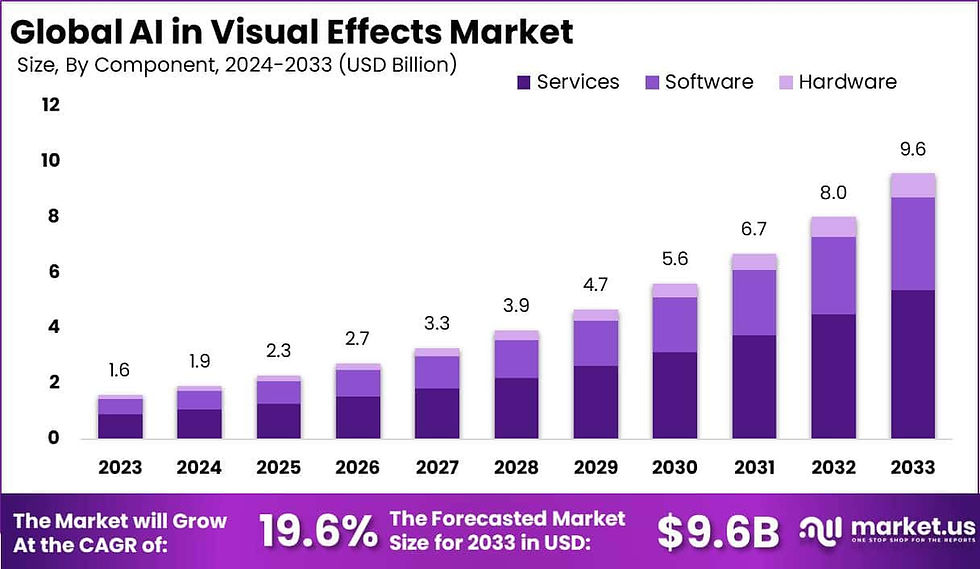
This transformation comes at a time when the global VFX market has surged in value, hitting over $10 billion in 2023, while AI-driven VFX is projected to grow at 25% annually, reaching $712 million by 2030. Hollywood’s 2023 strikes even highlighted AI as a defining industry issue, proof of how disruptive and powerful the technology has become.
From autonomous rotoscoping to facial animation, crowd simulation, set extension, and deepfake compositing, AI is augmenting human creativity and revolutionizing the future of filmmaking, gaming, advertising, and immersive media. In this article, we explore how AI is reshaping every corner of the VFX pipeline and what this means for the next generation of digital production.
Table of Contents
What Is AI in VFX?

AI in VFX refers to using machine learning, neural networks, and deep-learning algorithms to automate, accelerate, and enhance the creation of digital imagery. These systems learn patterns from large datasets, video sequences, facial capture, textures, physics simulations and use that knowledge to:
Generate realistic animations
Predict object movement
Remove noise from renders
Perform rotoscoping
Extend environments
Create digital humans
Simulate crowds
Automate compositing tasks
AI doesn’t replace VFX artists, it amplifies their abilities, handling repetitive tasks so creators can focus on high-level artistry and storytelling.
To understand VFX fundamentals, readers may refer to:
What is Visual Effects? → https://www.mimicvfx.com/post/what-is-visual-effects
Difference Between CGI & VFX → https://www.mimicvfx.com/post/difference-between-cgi-and-vfx
Why AI Is Transforming Modern Visual Effects

Traditional VFX pipelines require heavy manual work, tracking, masking, rigging, animating, compositing, and rendering each take hours or days. AI radically changes this dynamic through:
AI advantages include:
Speed: Weeks-long rotoscoping now takes minutes.
Cost reduction: Fewer manual hours = smaller budgets.
Accuracy: Neural networks detect micro-details humans might miss.
Realism: AI enhances texture quality, lighting accuracy, and movement authenticity.
Scalability: AI handles large data and complex scenes effortlessly.
AI isn't just a tool, it’s a paradigm shift across the entire creative pipeline.
How AI Works Across the VFX Pipeline
AI integrates into nearly every part of production:

Pre-production
AI-driven previs & storyboarding
Automated animatics
AI concept art generation
Production
Real-time performance capture
Virtual production enhancements
Automated background replacements
Post-production
Rotoscoping
Cleanup
Simulation
Rendering
Compositing
Digital human creation
This synergy is particularly powerful in film, games, advertising, and immersive XR, such as those showcased on:
Mimic Film Portfolio → https://www.mimicvfx.com/film
Mimic Games → https://www.mimicvfx.com/game
Immersive Experiences → https://www.mimicvfx.com/immersive
Commercials & Advertising → https://www.mimicvfx.com/advertising
Core Applications of AI in VFX

Below are the most transformative uses of AI in VFX, backed by industry case studies and modern workflows.
A. Autonomous Rotoscoping
Traditional rotoscoping is repetitive and painstaking. AI now automates:
Object segmentation
Edge detection
Matte generation
Motion tracking
AI excels especially when integrated into solutions like those offered at:
Mimic AI VFX → https://www.mimicvfx.com/ai-vfx
B. Realistic Facial Animation
AI analyzes real facial expressions to generate:
Micro-movements
Lip sync
Eye motion
Emotional subtleties
Disney’s neural network-based technologies, for example, enabled the creation of Sully’s nuanced facial performance in Monsters University.
AI facial animation tools can process:
Performance transfer
Emotion blending
Deepfake-level realism
C. AI-Powered Crowd Simulation
AI tools like Massive and Golaem simulate:
Autonomous decision-making
Realistic crowd behavior
Physically accurate motion
These systems reduce production time from weeks to hours and provide high diversity without thousands of extras.
D. AI-Driven Set Extensions & Environments
NeRFs (Neural Radiance Fields) enable:
Full 3D scene creation from 2D images
Intelligent interpolation of missing details
Photorealistic environment augmentation
This eliminates extensive greenscreen setups and expensive location shoots.
E. Accelerating VFX Rendering & Production
AI-based render engines deliver:
Real-time denoising
Faster global illumination
Upscaling low-res frames to 4K/8K
In Avengers: Infinity War, Digital Domain used machine learning to morph actor Josh Brolin into Thanos, significantly increasing production speed and realism.
AI in VFX vs. Traditional VFX Processes
Feature | Traditional VFX | AI-Powered VFX |
Rotoscoping | Manual, frame-by-frame | Automated, near-instant |
Facial Animation | Keyframing, motion capture rigs | Neural networks, video-based |
Rendering | Hours per frame | Real-time denoising & prediction |
Crowd Simulation | Manual agent setup | Autonomous behavioral learning |
Set Extension | Manual matte painting | AI-generated 3D environments |
Cost | High labor cost | Leaner, efficient pipeline |
Creative Focus | Limited by repetitive tasks | Artists focus on storytelling |
Industry Use Cases Across Film, Games, Advertising & Immersive Media

Film
AI is used to:
Replace faces
Recreate actors
Generate stunt doubles
Produce entire environments
See examples of cinematic applications:https://www.mimicvfx.com/film
Gaming
AI accelerates:
Real-time character animation
Procedural worlds
Metahuman performance
Real-time rendering
More gaming applications here:https://www.mimicvfx.com/game
Advertising
Brands now create:
Digital ambassadors
Dynamic crowd scenes
AI-driven product storytelling
Explore advertising case studies:https://www.mimicvfx.com/advertising
Immersive Experiences
AI powers:
XR simulations
Holographic effects
Interactive virtual characters
See immersive projects:https://www.mimicvfx.com/immersive
Benefits of Integrating AI in VFX
1. Automation of Repetitive Tasks
Rotoscoping
Object removal
Tracking
Cleanup
2. Enhanced Creative Freedom
Artists focus on narrative, detail, and storytelling.
3. Higher Realism
AI improves:
Lighting accuracy
Texture fidelity
Facial expression realism
4. Democratization of VFX
Small studios can now produce Hollywood-level effects.
5. Production Cost Savings
Automation lowers labor and rendering costs.
6. Faster Delivery Timelines
Crucial for high-output industries like episodic streaming.
Challenges and Limitations
1. Job Displacement Concerns
Automation threatens repetitive roles, though new AI-focused careers emerge.
2. Data Quality Issues
Biased or incomplete datasets produce suboptimal results.
3. Ethical Risks
Deepfakes, digital doubles, and actor recreation raise legal and moral concerns.
4. Over-reliance on AI
AI can create “generic” looks without artistic direction.
5. Complex Scene Handling
Scenes with extreme motion or overlapping elements still need human intervention.
Future Outlook: Where AI Is Taking VFX Next
The next decade of AI in VFX will redefine digital production entirely:
1. Real-Time AI Filmmaking
Live-action scenes rendered with VFX instantly
Directors can visualize final shots on set
2. Fully AI-Generated Films
AI could:
Write scripts
Animate characters
Render scenes
Simulate cinematography
3. Personalized Interactive CGI
Games will dynamically adjust environments based on player behavior.
4. Hyperreal Digital Humans
Ethical but inevitable—AI actors will co-exist with human ones.
5. AI + Virtual Production Synergy
Tools like Unreal Engine + AI will remove traditional post-production bottlenecks.
Mimic VFX stays at the frontier of these innovations:https://www.mimicvfx.com/ai-vfx
FAQs About AI in VFX
1. What is AI in VFX?
AI in VFX refers to using machine learning to automate tasks like rotoscoping, facial animation, rendering, and compositing.
2. Does AI replace VFX artists?
No - AI enhances productivity by removing repetitive tasks while artists focus on creativity.
3. How does AI speed up VFX production?
AI reduces:
Rotoscoping time
Render times
Manual tracking
Scene cleanup
4. What industries benefit most from AI in VFX?
Film, games, advertising, XR, and streaming content creation.
5. Is AI VFX expensive to implement?
Initially yes, but long-term savings in labor and time make it cost-effective.
6. What tools use AI for facial animation?
DeepMotion, MetaHuman Animator, and proprietary studio tools.
7. How does AI improve CGI realism?
It enhances textures, lighting, micro-expressions, and fluid simulations.
8. Will AI create entire films on its own?
Eventually possible, AI engines can already generate short sequences.
Conclusion
AI isn’t just changing the VFX pipeline, it is redefining the future of digital storytelling. From automated rotoscoping to real-time rendering and digital humans, AI in VFX enhances creativity, cuts costs, and dramatically accelerates production cycles. As the industry embraces this shift, studios that adopt AI will push innovation forward, while those that resist risk being left behind.
Mimic VFX remains at the forefront, combining technical mastery with AI-enhanced workflows to deliver world-class cinematic visuals, immersive experiences, real-time animation, and groundbreaking digital humans. Whether you're producing a film, game, commercial, or virtual world, Mimic’s expertise ensures your vision is executed with precision, and elevated by the power of AI.


Comments