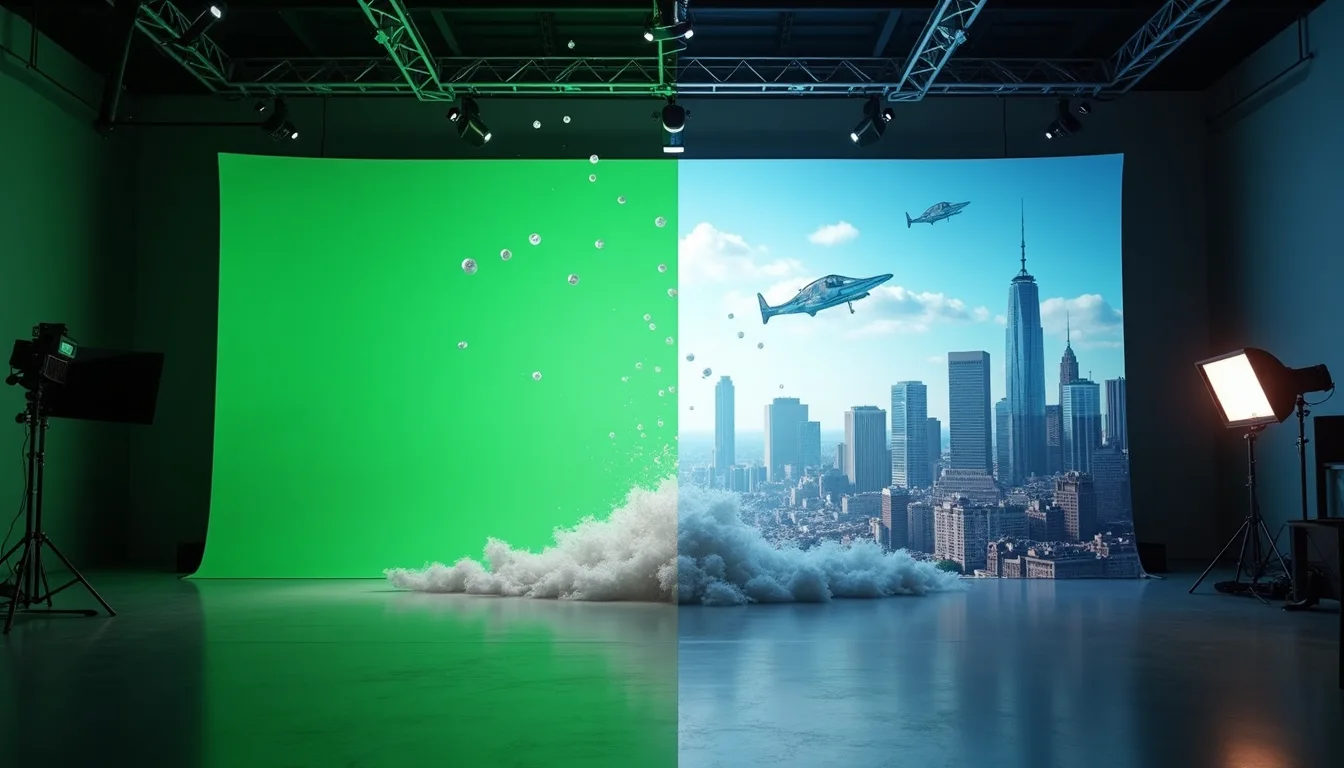
Music videos sit in a unique space between film craft and pure visual instinct. They do not need to obey narrative rules the way a feature does, but they still need continuity, intent, and image discipline to land as memorable cinema. When an artist pivots from performance to spectacle, or from intimacy to myth, visual effects become the grammar that makes that shift believable.
At Mimic VFX, we treat vfx for music videos as a production pipeline problem first, and a style problem second. The look can be surreal, minimal, glossy, raw, or painterly, but the work still has to hold up under motion, lighting, lens language, and editorial rhythm. That is where the difference is made: not in the idea, but in how cleanly the idea survives the cut.
The most iconic clips feel effortless because the invisible work is precise. Matchmove, roto, comp, CG integration, color continuity, and render strategy all have to support performance, not bury it. When the effects disappear into the timing of a song, the result feels like magic, even when the work is deeply technical.
Table of Contents
Why Music Videos Demand Film Grade VFX
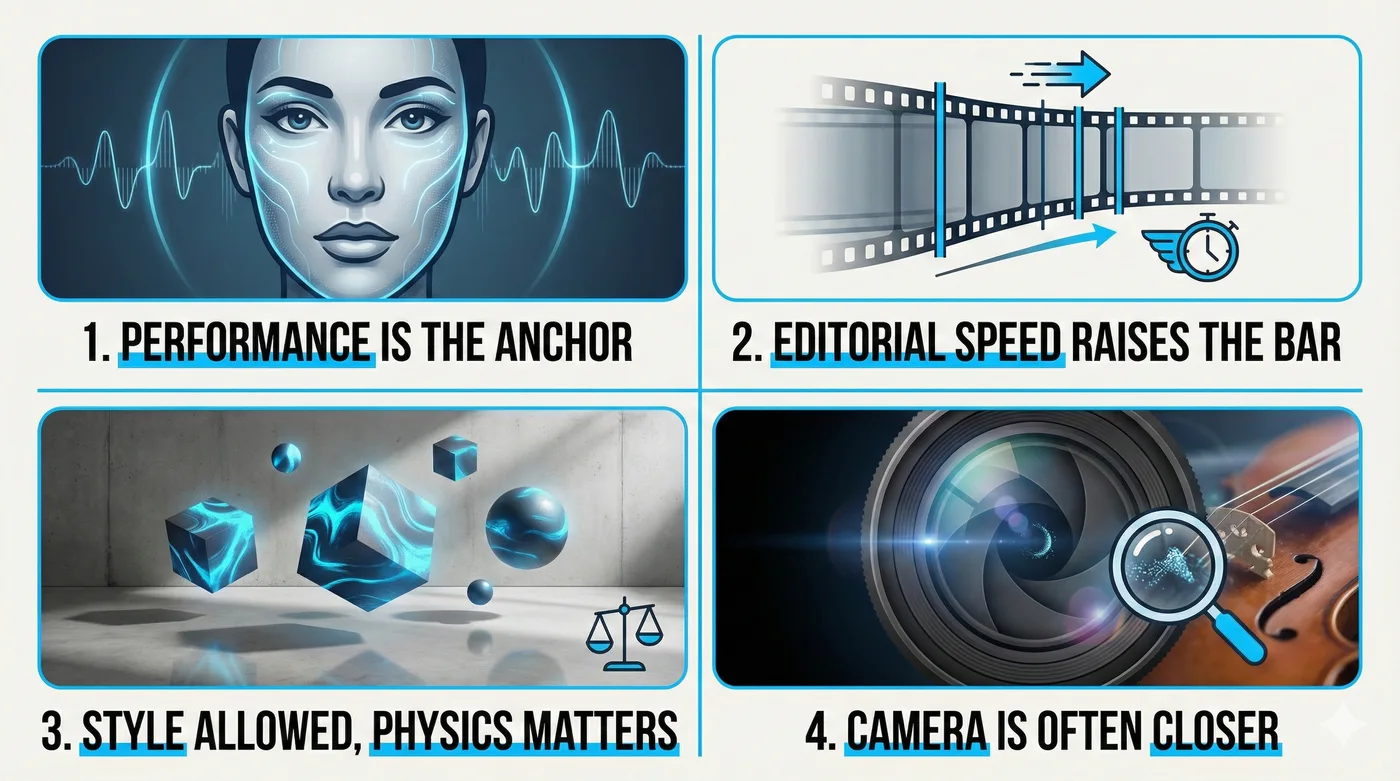
A music video is built on rhythm, not dialogue. That changes how effects are designed and judged. A single shot might only live for 18 frames, but it still has to read as physically coherent, emotionally aligned, and visually authored.
1. Performance is the anchor:
Even in heavy effects pieces, the human face is the truth meter. Any warp in eyelines, skin detail, lens behavior, or lighting continuity pulls the viewer out instantly. Digital humans, CG wardrobe elements, and beauty work must respect the real capture, not overwrite it.
2. Editorial speed raises the bar
Fast cutting makes errors harder to spot, but it also makes intent harder to preserve. If a transition relies on a match cut, a simulated element, or a composite wipe, the pipeline must protect those beats from plate changes and late edit shifts.
3. Style is allowed, physics still matters
A clip can push dream logic, but the viewer still believes in contact, weight, perspective, and light transport. This is why vfx for music videos often leans on film language fundamentals: lens choice, camera movement, and on set lighting discipline that gives post a stable foundation.
4. The camera is often closer than you think
Many music videos live in close ups, macro detail, and stylized beauty. That means cleanup, skin work, hair fixes, and micro tracking become high effort tasks, even when the final result feels subtle.
The Production Pipeline That Turns a Track Into Cinema
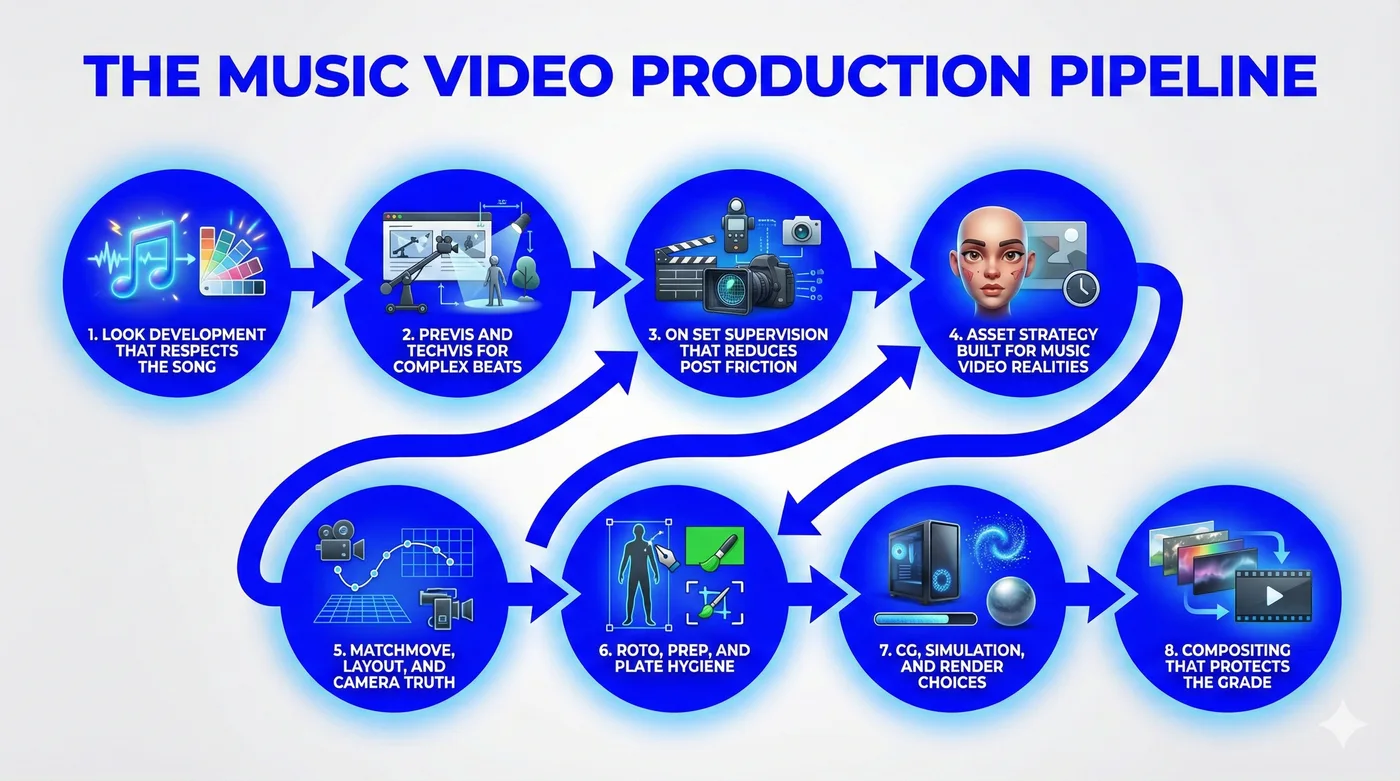
A strong music video pipeline is built to protect both performance and design. It needs enough structure to stay stable, and enough flexibility to evolve when the cut changes.
Short intro: Here is how the work typically moves from set to final frames without losing creative intent.
1. Look development that respects the song
We map visual motifs to the track structure: verse language, hook language, and bridge language. This might mean shifting lens behavior, altering atmosphere density, or moving from practical light to CG driven light in a controlled arc.
2. Previs and techvis for complex beats
When a shot needs a CG environment extension, a creature pass, volumetric light, or multi layer comp, previs is not only for spectacle. It is for planning parallax, focal length, and camera travel so the composite will hold.
3. On set supervision that reduces post friction
Clean plates, witness marks, lens grids, HDRI capture, texture reference, and measured lighting keep the comp honest. Good data capture also speeds up matchmove and reduces guesswork in integration.
4. Asset strategy built for music video realities
Unlike long form film, music videos often need high impact assets with tight deadlines. We prioritize what will be seen: hero face detail, key costume forms, readable silhouettes, and lighting response. Background complexity is built to support the frame, not compete with it.
5. Matchmove, layout, and camera truth
Camera solves must reflect the lens and the physical movement. When the camera language is handheld, the CG must inherit that living motion. When the shot is locked, any drift becomes obvious.
6. Roto, prep, and plate hygiene
Roto in music videos can be brutal because of hair, motion blur, smoke, and stylized lighting. Prep is where the shot becomes controllable: garbage masks, edge strategy, cleanup, and stabilization choices that make compositing faster and cleaner.
7. CG, simulation, and render choices
Real time previews help directors and editors feel changes quickly, but final pixels often come from offline rendering for fidelity, especially in close ups. The best approach is hybrid: real time for iteration, offline for final frames that need photoreal light and material response.
8. Compositing that protects the grade
Comp is where everything becomes one image: lens distortion, grain strategy, chromatic behavior, atmospherics, and integration. The goal is not to show effects, it is to preserve the shot as if it was always captured that way. This is where vfx for music videos either becomes invisible craft or obvious layering.
Comparison Table
Approach | Best for | Typical tools and methods | Strengths | Watchouts |
In camera practical effects | Performance driven realism, tactile atmosphere | Practical rigs, projection, lighting gags, set builds | Authentic light response, fast editorial trust | Less flexibility in post, reset time on set |
2D compositing and plate work | Beauty, cleanup, extensions, stylized transitions | Roto, prep, keying, multi pass comp, lens workflows | Highly controllable, efficient for many shots | Edge quality and grain continuity must be perfect |
Full CG shots | Impossible camera moves, environments, creatures | Matchmove, layout, modeling, surfacing, lighting, offline render | Total creative freedom, consistent control | Needs strong art direction to avoid synthetic feel |
Hybrid CG integration | Digital doubles, hero props, set augmentation | CG elements merged into plates, render passes, comp integration | Photoreal impact with real performance | Lighting reference and lens matching are critical |
AI assisted workflows | Concept iteration, select roto speedups, texture support | Guided tools, supervised cleanup, controlled generation passes | Faster exploration, targeted efficiency | Consistency, identity integrity, and legal clearance |
Applications Across Industries
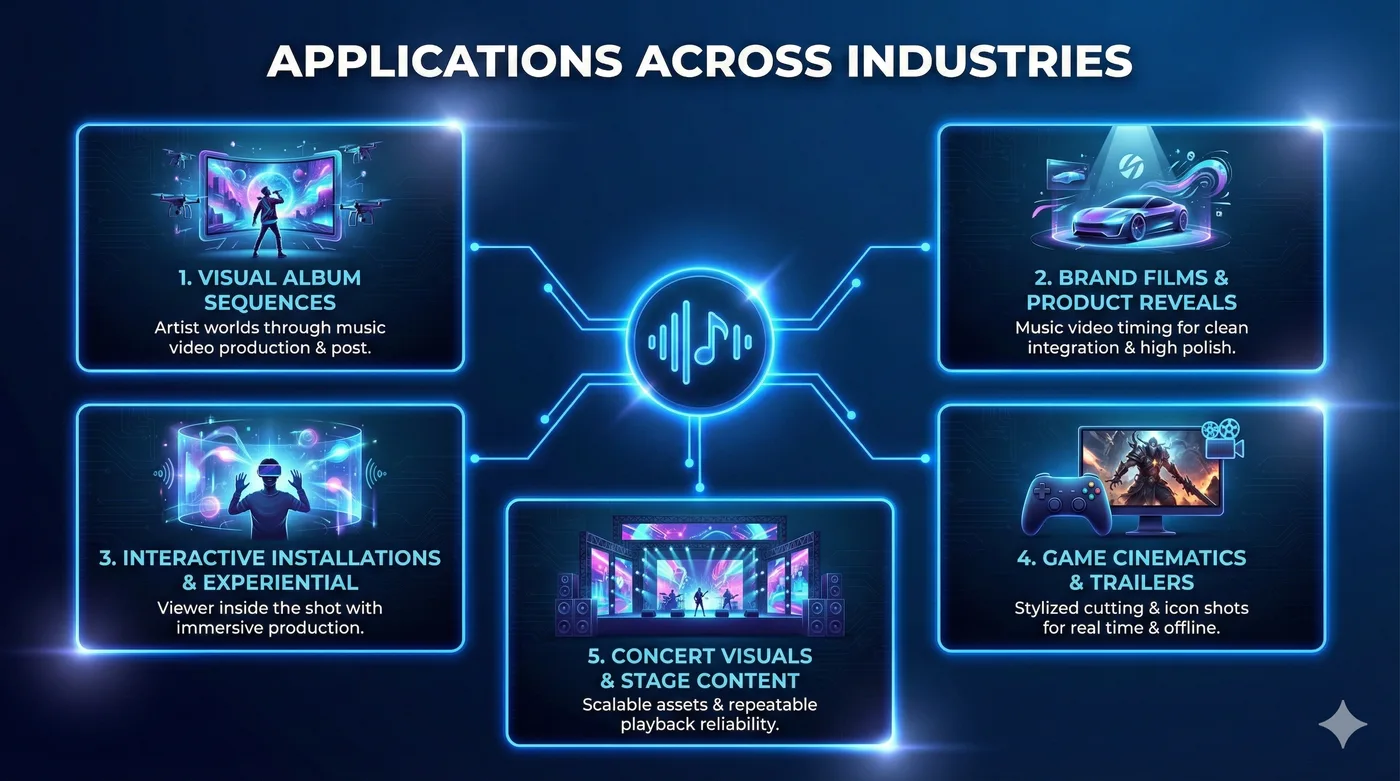
Music video language travels. The same grammar that sells a chorus can sell a product, a trailer moment, or an immersive installation, as long as the pipeline stays disciplined.
Visual album sequences and artist worlds built through music video production and post pipelines that prioritize performance continuity alongside bold design choices
Brand films and product reveals that borrow music video timing, supported by advertising focused VFX craft for clean integration and high polish delivery
Interactive installations and experiential content where the viewer is inside the shot, enabled by immersive production approaches that blend environment, light, and motion with intent
Game cinematics and narrative trailers that use the same stylized cutting and icon shots, tuned for real time review and offline final frames
Concert visuals and stage content that require scalable assets, consistent look control, and repeatable playback reliability
Benefits
When the work is done with film discipline, the results go beyond spectacle. The effects become storytelling tools that let an artist shift identity, scale, and reality without breaking performance truth.
Expands creative vocabulary without losing authenticity
Enables impossible locations, scale shifts, and camera moves
Protects performance while enhancing mood and mythology
Creates signature motifs that audiences associate with an artist
Supports faster iteration through look dev and controlled reviews
Makes transitions and editorial beats feel designed, not accidental
Used carefully, vfx for music videos can feel like a natural extension of the track: the visuals become another instrument in the mix.
Challenges
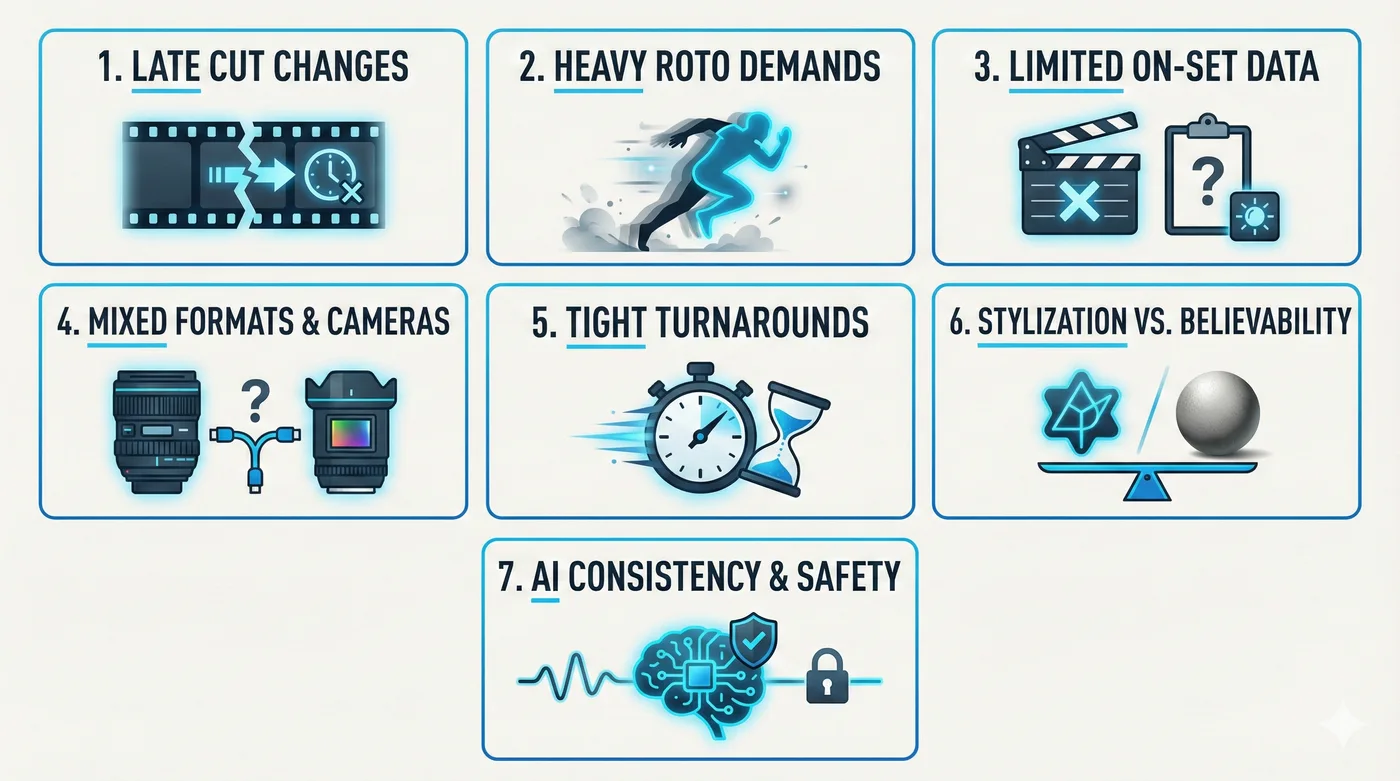
Music videos move fast, and the constraints are real. A premium result comes from solving the right problems early, not from brute force fixes at the end.
Late cut changes that break match cuts and transition logic
Heavy roto demands from hair, smoke, strobe lighting, and motion blur
Limited on set data capture that makes lighting recreation harder
Mixed formats and cameras that complicate lens and color continuity
Tight turnarounds that require an efficient asset and comp strategy
Balancing stylization with believable light, texture, and weight
Keeping AI assisted passes consistent and clearance safe when used
Future Outlook
The future of music video work is not just more technology, it is more control. Artists want bolder worlds with tighter identity, and that demands pipelines that can iterate quickly without losing realism.
Real time engines will keep pushing preproduction, layout, and lighting exploration. Directors will make stronger decisions earlier because they can see more of the final intent on day one. Offline rendering remains critical for hero close ups, skin fidelity, complex light transport, and nuanced integration. The winning approach is hybrid, designed around the shot, not around a single tool.
AI will matter most when it is supervised and production safe. Used within a studio pipeline, it can accelerate exploration and reduce repetitive labor, but it still needs human eye, continuity discipline, and clear approvals. For a deeper look at controlled integration, see our AI driven VFX workflow approach where the goal is reliability, not novelty.
As music videos continue to borrow from cinema language, the boundary between clip and film craft keeps thinning. The best work will feel like a feature moment compressed into minutes, backed by pipelines proven in film VFX production where performance, lighting, and editorial intent are treated as one system.
FAQs
What makes VFX in music videos different from film VFX
The rhythm of the edit is the boss. Shots can be shorter, transitions can be more aggressive, and style can be bolder, but the fundamentals of lens, light, and integration still apply.
How early should VFX be involved in a music video
As early as the concept and shot design stage. If an idea depends on camera travel, match cuts, or CG integration, planning early prevents expensive fixes later.
Do music videos usually use CG characters or digital doubles
They can, especially for identity shifts, stunts, or stylized worlds. The key is performance capture quality and a comp strategy that keeps the face and eyelines believable.
Is real time rendering enough for final music video shots
Real time is excellent for iteration and previews. Final frames often still benefit from offline rendering for close ups, complex lighting, and high fidelity materials.
What shots tend to cost the most in post
Hair heavy roto, smoke, strobe lighting, complex simulations, and shots with minimal motion blur where edges must be perfect. Close ups with heavy beauty work also add time.
How do you keep effects from looking layered or artificial
Match the lens, match the light, and respect the plate. Grain strategy, black levels, subtle atmospherics, and correct edge behavior are often more important than adding detail.
Can AI help with music video VFX safely
Yes, when it is used in a controlled way. It works best for guided exploration and select efficiency gains, with strict oversight for consistency, identity integrity, and approvals.
Conclusion
Iconic music videos do not become cinematic through scale alone. They become cinematic through intent: a camera language that makes sense, lighting that feels authored, and effects that serve performance rather than replace it. When the pipeline is built correctly, the viewer never thinks about the composite. They only feel the moment.
At Mimic VFX, we approach vfx for music videos with the same discipline we bring to film grade work: clean capture, strong planning, and meticulous integration. The goal is not to chase trends. The goal is to build frames that hold up, cut after cut, and still feel like they belong to the artist when the song ends.